Musculoskeletal Ultrasound Miami | Ross Medical Group
Diagnostic Musculoskeletal Ultrasound in Miami: How Dr. David Ross Uses Ultrasound to Diagnose Sports Injuries and Guide Orthopedic Injections
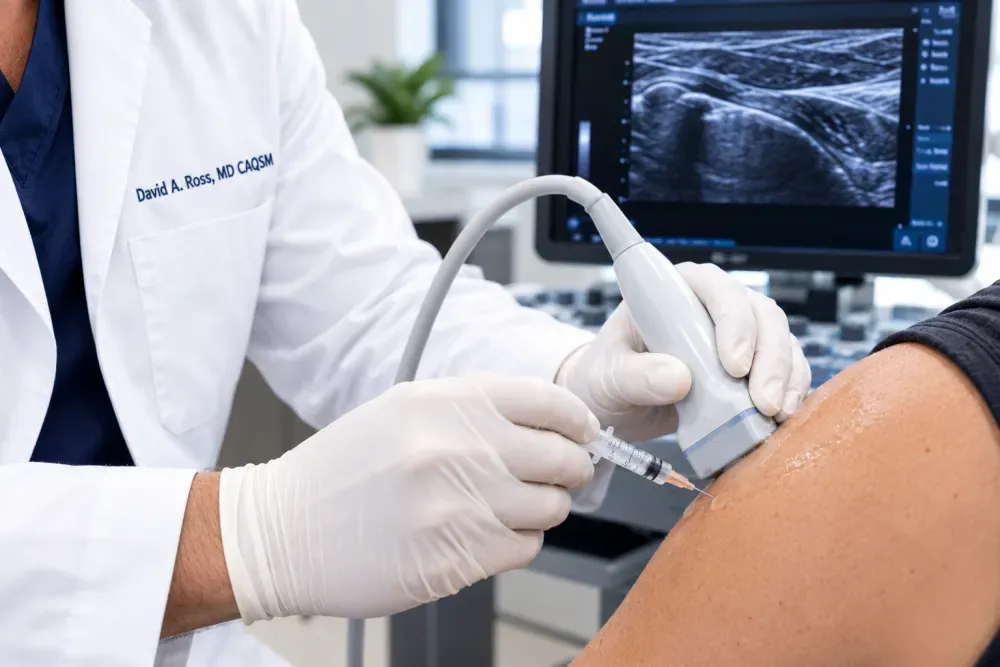
When it comes to diagnosing sports injuries and treating orthopedic pain, seeing the problem clearly can make a meaningful difference in treatment planning. Diagnostic musculoskeletal ultrasound allows physicians to evaluate many muscles, tendons, ligaments, bursae, and other soft tissue structures in real time. In sports medicine, this technology can also guide injections with direct visualization of the needle and intended treatment site.
At Ross Medical Group in Miami, Florida, Dr. David A. Ross, MD, CAQSM, combines specialized sports medicine training with diagnostic musculoskeletal ultrasound and ultrasound-guided orthopedic procedures to evaluate and treat a range of acute injuries and chronic musculoskeletal conditions.
Dr. Ross is dual board-certified in Family Medicine and Primary Care Sports Medicine and completed his sports medicine fellowship at the University of Pennsylvania. His previous experience includes caring for athletes with the Philadelphia Flyers of the NHL, the Philadelphia Eagles of the NFL, and the University of Pennsylvania's NCAA Division I athletic programs.
For patients searching for a sports medicine physician in Miami who offers diagnostic ultrasound and ultrasound-guided injections, Dr. Ross provides an individualized approach to evaluating musculoskeletal problems and selecting appropriate treatment options.
What Is Diagnostic Musculoskeletal Ultrasound?
Diagnostic musculoskeletal ultrasound, also called MSK ultrasound or sports medicine ultrasound, is a noninvasive imaging technique that uses high-frequency sound waves to visualize structures beneath the skin.
Unlike X-rays, ultrasound does not use ionizing radiation. It can provide real-time images of many tendons, muscles, ligaments, superficial nerves, bursae, and joints. Because the examination can be performed while a body part moves, it may also help identify abnormalities that change with movement.
When clinically appropriate, musculoskeletal ultrasound can help evaluate:
-
Shoulder pain: Rotator cuff tendinopathy, selected rotator cuff tears, and subacromial-subdeltoid bursitis.
-
Elbow pain: Tennis elbow, golfer's elbow, and selected tendon injuries.
-
Hip pain: Greater trochanteric bursitis and gluteal tendinopathy.
-
Knee pain and swelling: Joint effusions, selected superficial soft tissue abnormalities, and tendon injuries.
-
Ankle and foot pain: Achilles tendinopathy, plantar fasciopathy, and other selected soft tissue conditions.
-
Muscle injuries: Certain muscle strains, tears, and fluid collections.
-
Nerve-related conditions: Selected superficial nerve abnormalities and entrapment syndromes.
Why Use Ultrasound During a Sports Medicine Evaluation?
A thorough sports medicine assessment begins with a detailed medical history and physical examination. Diagnostic ultrasound can provide additional information when a particular muscle, tendon, bursa, or other accessible structure needs closer evaluation.
At Ross Medical Group, Dr. David Ross incorporates diagnostic musculoskeletal ultrasound into the evaluation of appropriate orthopedic and sports-related conditions.
Potential advantages include:
Real-time assessment. The physician can examine selected structures dynamically, including during movement, rather than relying exclusively on static images.
Targeted evaluation. Ultrasound can help assess a specific area of pain or swelling identified during the history and physical examination.
Convenient imaging. When appropriate, ultrasound can be performed during the office visit, potentially allowing the physician to incorporate imaging findings into the initial treatment discussion.
Radiation-free imaging. Ultrasound uses sound waves rather than ionizing radiation.
Procedure planning. Diagnostic findings can help determine whether an injection, aspiration, rehabilitation, additional imaging, or another treatment approach may be appropriate.
Imaging findings must always be interpreted in the context of the patient's symptoms and examination. An abnormality on ultrasound does not necessarily mean it is the cause of a patient's pain.
Ultrasound-Guided Injections in Miami: Why Needle Visualization Matters
Musculoskeletal injections are used to treat selected joint, tendon-related, bursal, and other orthopedic conditions. Traditional injections may rely on anatomical landmarks and the physician's knowledge of underlying structures.
With ultrasound-guided injections, the physician uses real-time imaging to visualize relevant anatomy and guide the needle toward the intended target.
Research reviewed by the American Medical Society for Sports Medicine found that ultrasound-guided musculoskeletal injections are generally more accurate than injections performed using anatomical landmarks alone. Evidence for improvements in pain and function varies according to the specific procedure and condition.
At Ross Medical Group, Dr. Ross uses ultrasound guidance for appropriate orthopedic injections to improve anatomical targeting and visualize nearby structures during the procedure.
Depending on the patient's diagnosis, treatment options may include:
-
Corticosteroid injections for selected inflammatory musculoskeletal conditions.
-
Hyaluronic acid, or viscosupplementation, injections for selected joint conditions.
-
Platelet-rich plasma (PRP) injections for appropriate musculoskeletal indications.
-
Joint aspiration to remove fluid for diagnostic evaluation or symptom management.
-
Other selected ultrasound-guided musculoskeletal procedures.
Ultrasound-Guided PRP Injections in Miami
Platelet-rich plasma therapy is a treatment option used in sports medicine for certain tendon disorders, joint conditions, and other selected musculoskeletal problems.
PRP is prepared from a sample of the patient's own blood. The blood is processed to concentrate platelets in plasma, which contains biological signaling molecules involved in normal tissue repair.
At Ross Medical Group, PRP injections can be performed under ultrasound guidance when appropriate. Ultrasound helps the physician identify the intended anatomical target and guide needle placement during the procedure.
PRP may be considered for selected conditions such as:
-
Knee osteoarthritis.
-
Certain chronic tendon injuries.
-
Tennis elbow and golfer's elbow.
-
Selected patellar or Achilles tendon disorders.
-
Plantar fasciopathy.
-
Other carefully selected orthopedic and sports-related conditions.
Sports Medicine Ultrasound for Elite Athletes and Active Individuals
Accurate assessment of musculoskeletal injuries is important for athletes who need to return to training and competition safely.
Dr. David Ross has experience treating athletes across a broad range of sports, including professional hockey and football athletes and collegiate athletes competing in NCAA Division I programs. He also has a particular clinical interest in the demands of tennis and racquet sports.
For tennis players, runners, golfers, and other competitive athletes, ultrasound may help evaluate selected tendon injuries, muscle strains, bursitis, and other soft tissue problems.
When indicated, ultrasound findings can contribute to an individualized treatment and rehabilitation plan. Decisions about return to sport should also consider symptoms, physical examination, functional testing, sport-specific demands, and the nature of the injury.
Ross Medical Group welcomes inquiries from local, out-of-state, and international patients seeking sports medicine evaluation in Miami, Florida. Patients traveling for care should contact the practice in advance to coordinate records, prior imaging, and appointment arrangements.
Why Choose Dr. David Ross for Musculoskeletal Ultrasound in Miami?
Choosing a physician for an orthopedic injury involves more than choosing an imaging test. It requires clinical expertise to interpret the findings and determine what they mean for the patient's treatment.
Dr. Ross brings specialized sports medicine training and experience caring for athletes at professional and collegiate levels to his clinical practice at Ross Medical Group.
His qualifications include:
-
Dual board certification in Family Medicine and Primary Care Sports Medicine.
-
Sports medicine fellowship training at the University of Pennsylvania.
-
Previous team physician experience with the Philadelphia Flyers and Philadelphia Eagles.
-
Experience caring for University of Pennsylvania NCAA Division I athletes.
-
Current experience caring for professional MLB, NFL, WTA and ATP athletes as well as professional cyclists, endurance athletes such as marathoners and triathletes, among others.
-
Clinical focus on acute and chronic musculoskeletal conditions, diagnostic ultrasound, and ultrasound-guided orthopedic injections.
Ross Medical Group is a family-owned medical practice established in 1995. Its sports medicine services include diagnostic musculoskeletal ultrasound, ultrasound-guided injections, PRP therapy, and additional evaluation and treatment options for active individuals and athletes.
Schedule a Diagnostic Ultrasound or Sports Medicine Consultation in Miami
If you have persistent shoulder, elbow, hip, knee, ankle, or foot pain, diagnostic musculoskeletal ultrasound may help evaluate the cause when the suspected condition is suitable for ultrasound assessment.
Dr. David Ross provides sports medicine consultations at Ross Medical Group in Miami, Florida, and uses diagnostic ultrasound and ultrasound-guided procedures when clinically appropriate.
To learn more about diagnostic MSK ultrasound, ultrasound-guided injections, or PRP therapy, contact the practice to discuss your symptoms and appointment options.
Ross Medical Group
8200 SW 117th Avenue, Suite 100-200, Miami, FL 33183
Phone: 305-279-7677